
Interactive Web Report Update- September 2025
Pennsylvania Has Seen 115,619 Evictions in 2024: Here’s a Closer Look
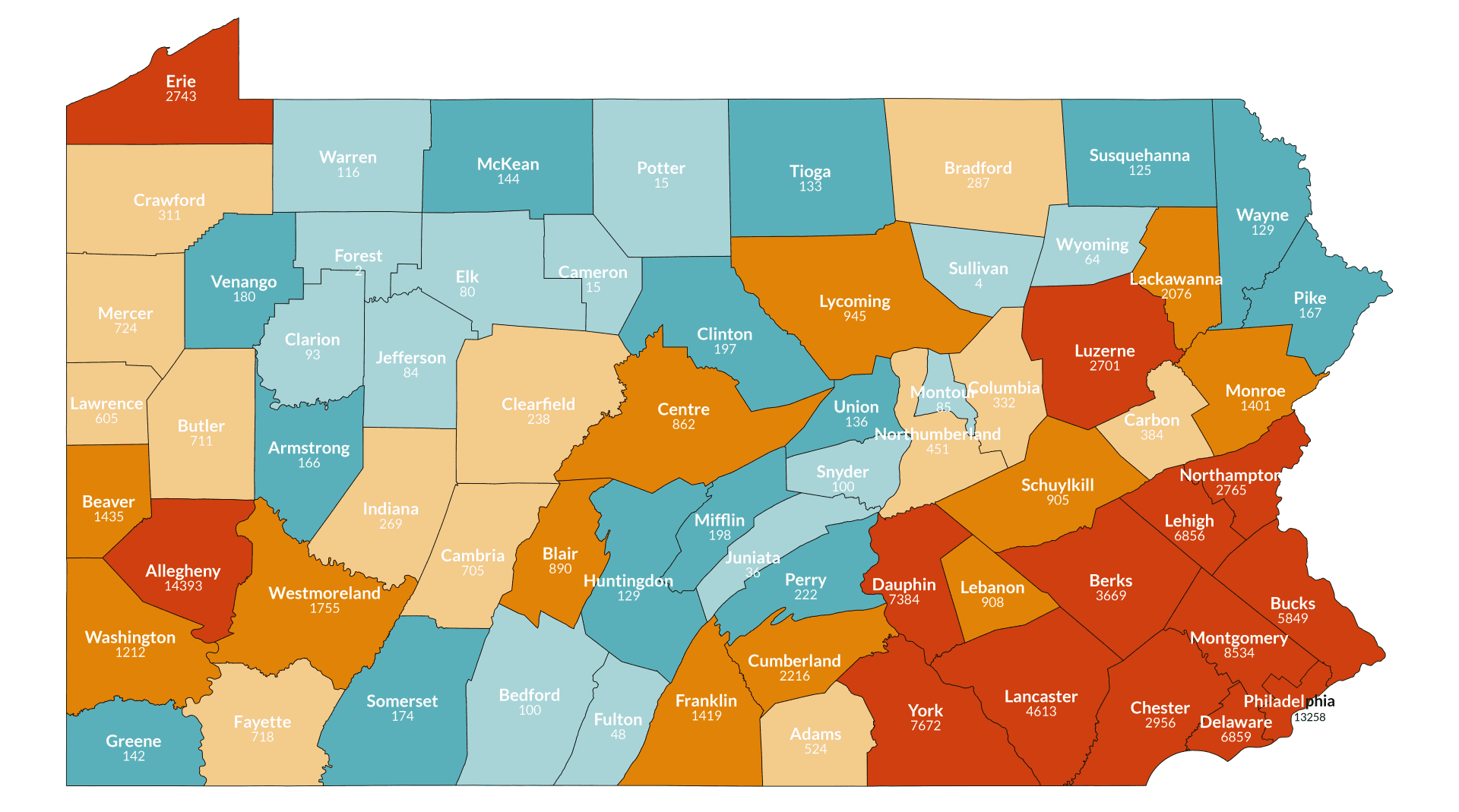
Eviction Filings across the State in 2024
Foreword
Pennsylvania is home to over 1.6 million renter households and a third are struggling with rent cost burden. This rent burden can lead to untenable situations, especially for the 425,212 extremely low-income renter households that are severely cost burdened. Many renters are forgoing basic necessities like food or medicine to make the rent. During the pandemic, the robust financial assistance programs and tenant protections afforded to struggling families cut the eviction crisis in half. Unfortunately, as those resources and protections dry up, there is a return to pre-pandemic filing rates.
During the pandemic, numerous eviction prevention programs were implemented across the state using Emergency Rental Assistance Program (ERAP) funds. These programs have continued to achieve success in keeping tenants housed, providing crucial support even as resources diminish.
This report is an update to “After the Pause: The Rise of Eviction Filings Post-Pandemic.” It evaluates how eviction filings and filing rates have changed over time, highlighting the communities where these changes are concentrated. The analysis is based on eviction filing data from the Administrative Office of Pennsylvania Courts, covering a six-year span from 2018 to 2024. You can also find information on solutions including evidence to make the case and resources to start a program in your community in our eviction prevention resource library.
Methodology
The eviction data presented in this report was sourced from the Administrative Office of Pennsylvania Courts (AOPC) for cases filed between 2018 and 2024. This dataset contains information available in publicly accessible docket sheets; such as the number of cases filed, the amounts of rent arrears awarded to landlords, judgment outcomes, and more. These data can be analyzed at the state, county, and ZIP Code Tabulation Area (ZCTA) levels.
To provide context and a broader perspective, data on renter households were also integrated into the analysis. This supplementary information was procured from the 5-year American Community Survey (ACS), with the most recent available dataset being from 2023.
To facilitate comparisons across different time periods, the dataset was structured into 12-month segments, encompassing periods before, during, and after the pandemic’s impact. The state-level case tracking system does not encompass Philadelphia’s eviction filings. In this regard, data specific to Philadelphia eviction filings were drawn from Eviction Lab’s publicly available data, accessible via their website, as well as data obtained from the Legal Services Corporation. The Philadelphia dataset may lack some of the fields available in the AOPC data; therefore, many of our analyses do not include Philadelphia cases. These analyses are noted as such.
Main Findings
- In 2024, Pennsylvania saw 115,619 eviction filings, an increase of nearly 900 filings compared to the previous year (2023) and reaching 99.5% of pre-pandemic levels.
- Judgments for the plaintiff (the landlord) remain the most common outcome of court rulings. However, there has been a nearly equal increase in cases withdrawn and settled as decrease in judgement for the plaintiff when compared to pre-pandemic years . This trend can be attributed to the lasting impact of the Emergency Rental Assistance Program (ERAP) and the targeted eviction prevention programs implemented across the state.
- 317 renter households (or 1 in 14 renter households) face an eviction filing every day.
- 87% of eviction filings are concentrated in 20 counties in Pennsylvania. 80% renter households in Pennsylvania live in these same counties.
- 15 of those 20 counties have filing rates above the statewide average.
- The zip codes with the highest concentrations of eviction filings are the same compared to the pre-pandemic time period.
- Over 93% of cases involve past due rent demonstrating that non-payment of rent continues to be a main driver for eviction filings and resulting evictions.
- The share of tenants involved in eviction cases who are behind on rent by more than three months has increased from 26.4% before the pandemic to 28.4% in the most recent year.
- Two-thirds of judgments for the plaintiff (the landlord) provide an opportunity for tenants to pay the full judgment amount up until the moment of legal lockout, often called a “pay and stay.” It is possible that during this “pay and stay” window, payment plans and other agreements can be made to either preserve the housing opportunity or avoid immediate eviction of the tenant.
- More cases are continued now compared to pre-pandemic numbers, although not at the same rate at which cases were continued during the pandemic. The number of case continuances indicate a slowing down of the eviction process, that could potentially be due to rental assistance, eviction prevention services etc.
Eviction filings
Eviction Filings in 2024 Rose by Almost 900 Compared to 2023
Eviction Filings by Year
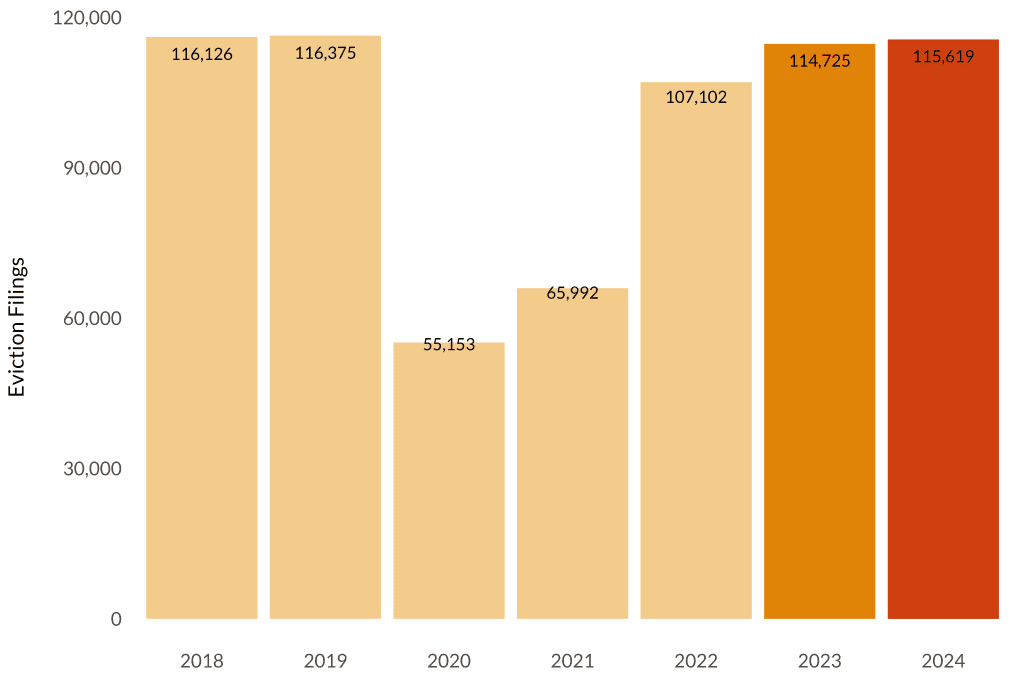
Before the pandemic, in 2018, Pennsylvania recorded approximately 116,126 eviction filings. As the pandemic took hold and eviction moratoria were enacted, the number of filings witnessed a substantial decline. The lowest point was recorded in 2020, totaling 55,153 filings, largely attributed to the implementation of the CDC moratorium. However, since the end of nationwide relief efforts, eviction filings have steadily risen.
In 2024, Pennsylvania recorded 115,619 filings; nearly 99.5% of the filings in 2018, and nearly 900 filings more than 2023. To put it in perspective, this implies that approximately 317 renter households face eviction filings daily in the state.
Eviction filing RATE
Over 1 in 14 Renter Households in PA are at Risk of Experiencing an Eviction Filing
Eviction Filing Rates by Year
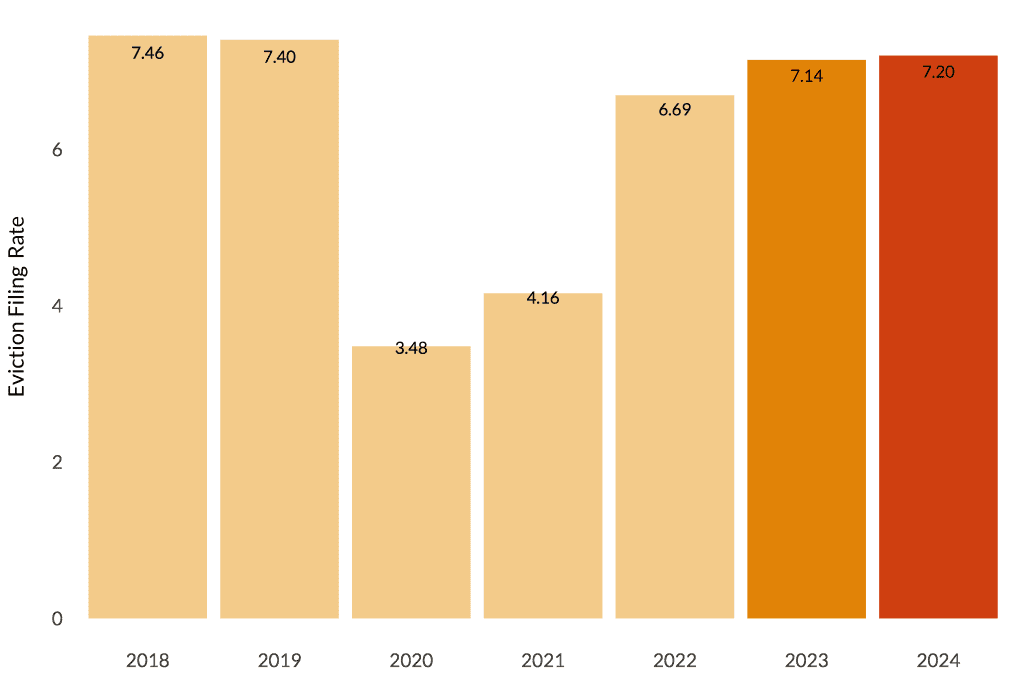
The eviction filing rate is a crucial metric used to gauge the frequency or incidence of eviction filings within a specific geographic area over a defined period, typically expressed as a percentage or as a rate per 100 households. Specifically, it reflects the proportion of rental households within that area that have had eviction cases initiated against them during the specified time frame.
In PA, the eviction filing rate followed a distinct trajectory. Before the pandemic, it was 7.46%, meaning that approximately 7.4 out of every 100 rental households faced eviction filings. As of 2024, Pennsylvania’s eviction filing rate has returned to pre-pandemic levels, reaching 7.2% – an increase from 2023. In Pennsylvania, 1 in every 14 renter households faces the risk of experiencing an eviction filing.
At the ZIP Code Level
Eviction Filing Rates by ZIP Code in 2024
Note: The interactive graph for Eviction Filing Rates by ZIP Code in 2023 can be found here.
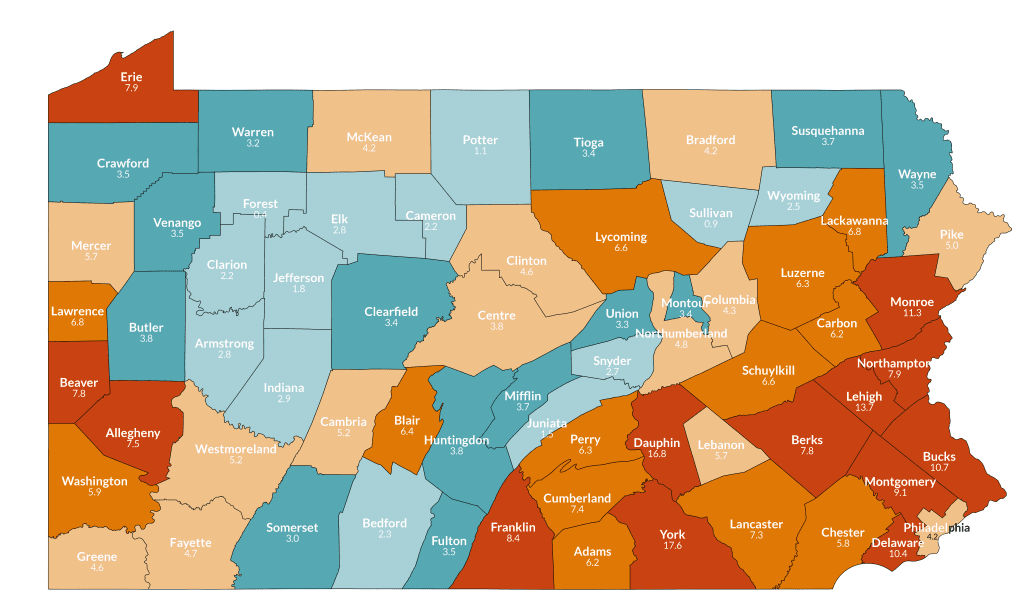
When examining filing rates at the neighborhood level using census designated ZCTAs, it becomes evident that changes in filing rates vary significantly across counties. The map below provides a classification of areas based on their filing rates in 2024. The regions marked in red and orange indicate filing rates that are approaching or surpassing the statewide average of 7.2%. Notably, these areas are populations centers where it is more likely to see concentration of vulnerable populations at risk of eviction.
ZIP codes with higher rates before the pandemic also tend to have higher rates at present. The areas marked in light and dark blue have relatively lower filing rates, below 3.3%, and have largely remained consistent before and after the pandemic.
Third Quarter Consistently Shows Peak Eviction Filings, Outside of Pandemic Years
Annual Eviction Filings by Quarter
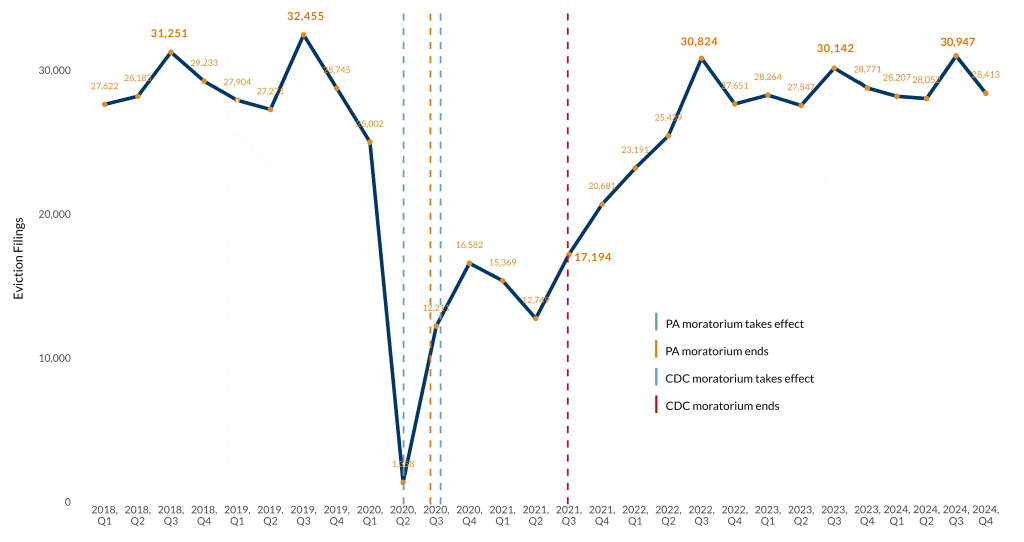
The graph above highlights a recurring trend where a significant portion of eviction filings take place during the third quarter of each year. Since 2018, the third quarter of each year (excluding pandemic years) has recorded the highest number of eviction filings. 2024 also saw a peak in the third quarter, with 30,947 filings—indicating a potential seasonal pattern in eviction activity.
Annual Eviction Filings by Quarter- County
Note: you can hover your cursor over the graph to view the number of cases for each quarter. You can choose specific counties from the dropdown menu below. Individual county plots are available for download using the ‘Download Plot’ button.
CASE OUTCOMES
While a Majority of Cases were Decided in Favor of the Landlord, an Increased Number of Cases are Withdrawn
Statewide Case Outcomes by Year (excluding Philadelphia)

-
Withdrawals and Settlements are crucial outcomes to monitor because they indicate that the landlord and tenant have reached an agreement or resolution outside of the court process. These outcomes often lead to better results for both the tenant and the landlord.
A landlord can withdraw a complaint by submitting written notice to the court before the hearing, resulting in the case being marked as withdrawn on the docket. Similarly, parties can inform the court of a settlement before judgment entry, leading to the case being marked as settled on the docket, and any scheduled hearings being canceled.
It is important to note that despite the rising number of filings, eviction prevention programs are still achieving positive results. These programs encompass various components that include rental and utility assistance, resource navigation, court coordination, landlord tenant mediation services, landlord engagement etc. Counties with diversion programs have experienced substantial increases in withdrawals and settlements, underscoring the significance of these initiatives. To learn more about eviction diversion programs across the state, visit our eviction prevention resource library .
After the initiation of an eviction case, a hearing is scheduled before a judge. Unless the case is withdrawn by the landlord or resolved through an agreement (i.e., settled between the landlord and tenant), the judge is tasked with rendering a decision. This decision can favor the plaintiff (typically the landlord), favor the defendant (typically the tenant), or result in the dismissal of the case without prejudice. A dismissal without prejudice means that the plaintiff or landlord retains the option to re-file the case at a later time, if needed.
As shown in the graph, judgments are overwhelmingly in favor of the plaintiff. However, this proportion has experienced a decline, dropping from 81% before the pandemic to 72% in the most recent year (2024). Concurrently, there has been a consistent uptick in the number of cases withdrawn since 2018, from 7% to 15%. In contrast, judgments for the defendant (the tenant) and cases settled have exhibited relatively stable patterns over time.
In 2024, a higher percentage of cases, nearly 23%, were continued compared to 16% in the period before the pandemic. The number of case continuances indicates a slowing down of the eviction process, that could potentially be due to rental assistance, eviction prevention services etc.
County Case Outcomes by Year (excluding Philadelphia)
93% of Eviction Cases Involve Back Rent
Statewide Rent in Arrears(excluding Philadelphia)
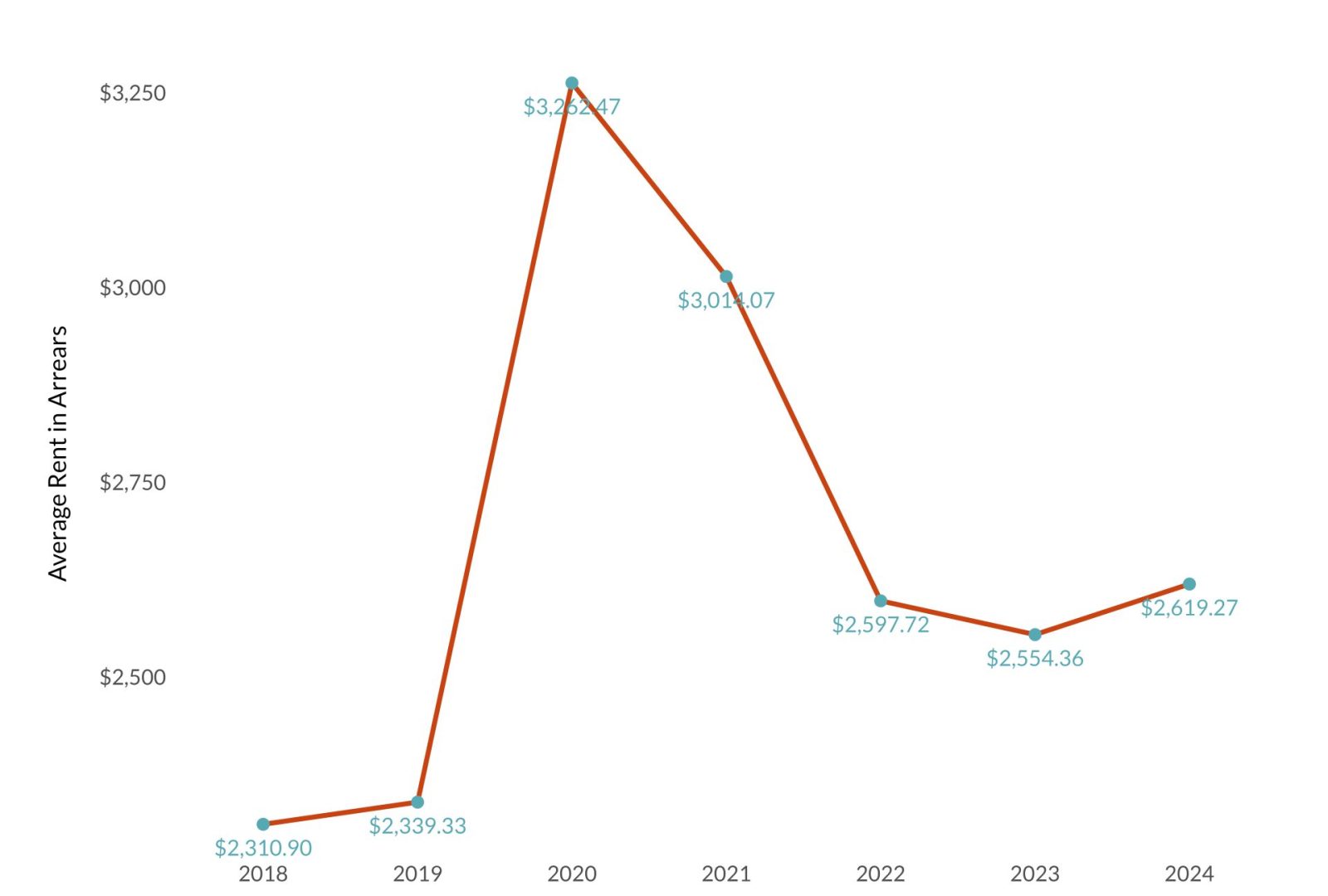
Tenants involved in eviction cases are further behind in rent this past year compared to before the pandemic. Prior to the pandemic, in 2018, approximately 26.4% of renters were behind by more than 3 months in their rent payments. However, this figure has escalated to 28.4% in 2024. Unpaid rent is either the sole or one of multiple reasons for a significant majority of eviction filings. In the graph shown, rent in arrears, often referred to as back or past due rent, is a claim in 93% eviction filings. While costs, filing fees, and server fees have maintained relatively stable figures over the years, attorney fees have nearly doubled in the past year compared to pre-pandemic levels. Judgment amounts vary significantly across the state. The additional fees and charges included in the judgment award can be significant and increase the debt on the tenant by as much as 21%.
County Rent in Arrears (excluding Philadelphia)
68% of Judgments for Plaintiff Provide a Small Window for Tenants to Pay Back Rent and Avoid Eviction
Statewide Grant of Possessions (excluding Philadelphia)

A grant of possession, with minor exceptions, is included as part of the judgment that returns possession of the property (i.e. rental unit) to the landlord, terminating the rights of the tenant to continue to live there. Only if a landlord is awarded possession of the property can they initiate the next step in the legal process, which is filing the order of possession. This will start the 14 day countdown to when the legal lockout takes place and tenants are forcibly removed from the property.
In 66% of cases where a judge has rendered a decision in favor of the plaintiff, most commonly the landlord, the tenant has an opportunity to pay the full judgment amount up until the moment of legal lockout, often called a “pay and stay .” It is possible that during this “pay and stay” window, payment plans and other agreements can be made to either preserve the housing opportunity or avoid immediate eviction of the tenant.
In the figure above, the number of cases in which possession was granted, either with or without conditions, has remained relatively stable over time, with fluctuations observed during the pandemic. The majority of orders of possession are issued approximately a month after a case is filed. Technically a landlord has up to 120 days to file the order of possession, though typically most happen immediately. In 2024, the median time between filing and the issuance of an order of possession was 37 days, compared to 35 days before the pandemic.
COUNTY SPECIFIC DATA
87% of Statewide Filings are Concentrated in 20 Counties
Top 20 Counties with the Highest Eviction Filings
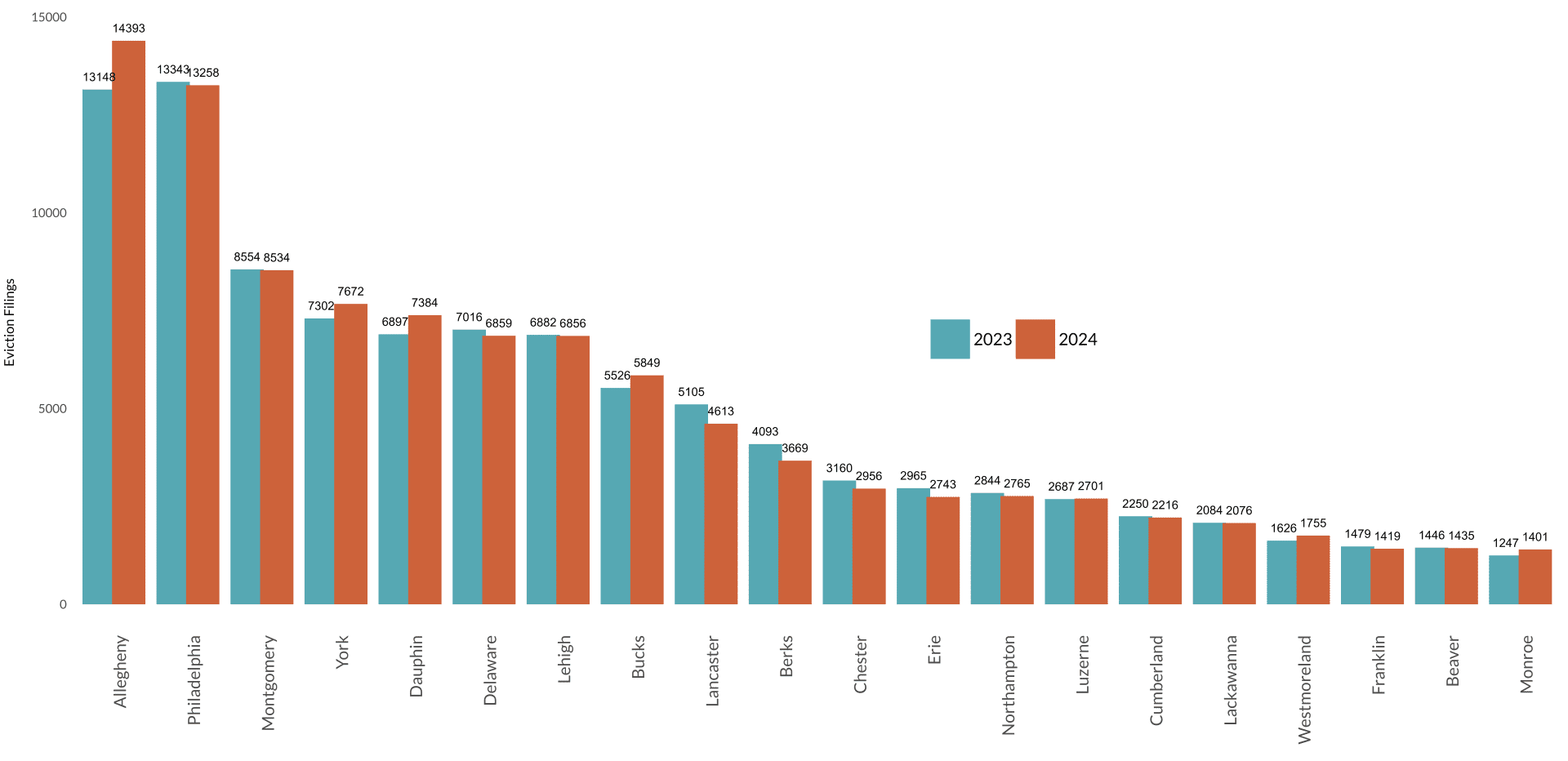
While statewide eviction filings in Pennsylvania are at pre-pandemic levels, there exist significant variations in both the number of filings and filing rates across counties. Notably, 87% of all statewide eviction filings are concentrated in just 20 counties, as illustrated below. This concentration aligns with the fact that these 20 counties also host a substantial number of renter households
Eviction filing rates
13 out of the Top 20 Counties have seen Decreases in Eviction Filing Rates since 2023
Eviction Filing Rates in Top 20 Counties
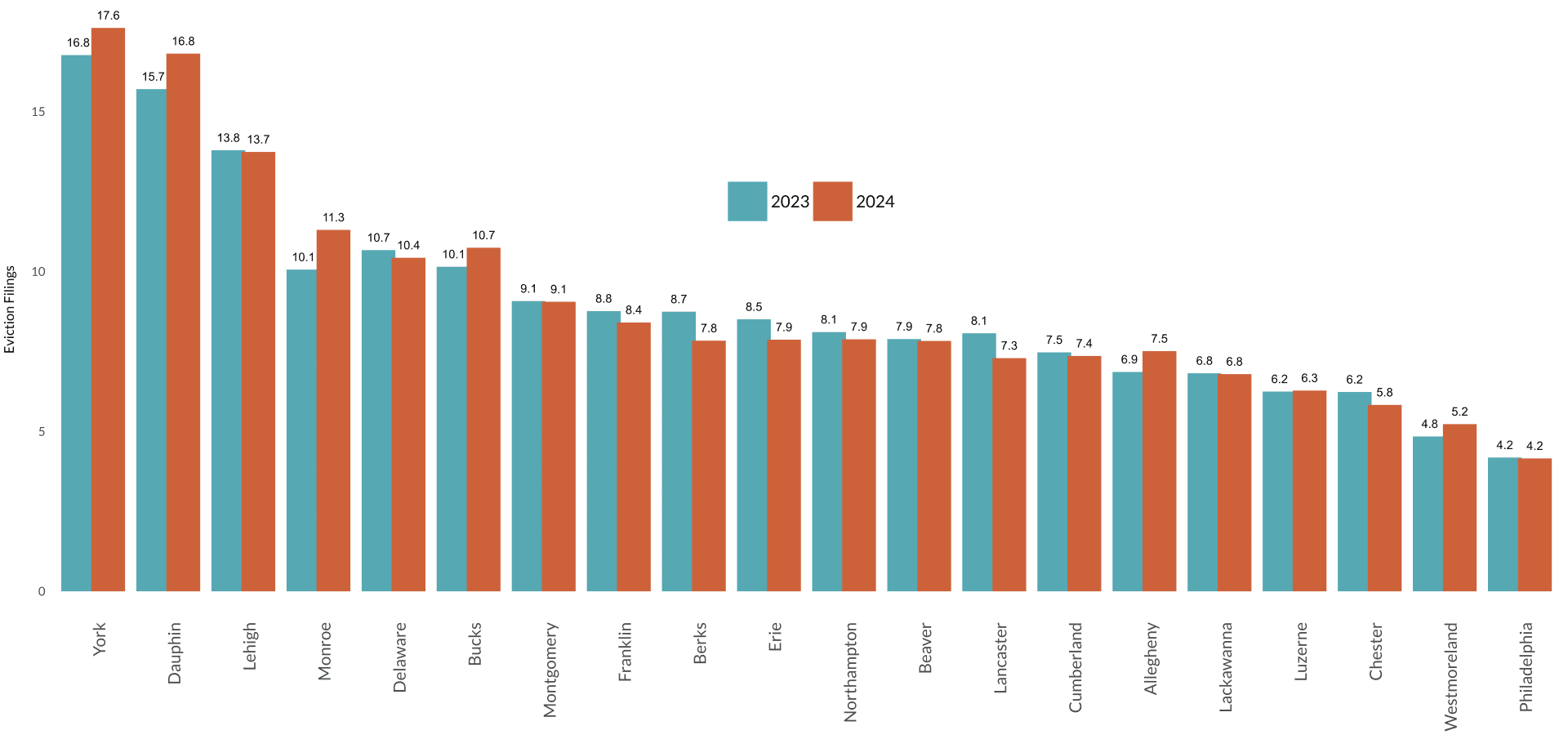
However, when we shift our focus to filing rates, a different narrative emerges. Counties such as Philadelphia and Allegheny, which have both the highest numbers of filings and the largest renter populations in the state, exhibit lower filing rates compared to counties with fewer renter households.
Examining filing rates helps us understand the severity of eviction challenges within a specific area because it takes into account the number of renter households. Philadelphia, Delaware and Lackawanna, and others have experienced decreases in both the number of filings and filing rates over time. On the contrary, counties like Allgheny, York and Dauphin have witnessed increases in both filing numbers and rates.
15 Counties have a Higher Filing Rate than the Statewide Average of 7.2%
Eviction Filing Rates across the State in 2024
Going Forward…
The harmful impact of eviction ripples through communities affecting families, landlords, businesses, schools, and communities. Eviction and efforts to prevent it are essential to ongoing efforts to achieve housing equity and justice in Pennsylvania.
The Housing Alliance is going to continue to evaluate the root causes of evictions, where they are taking place, and who is at risk. We are also going to continue to evaluate the community-based programs that divert and prevent evictions to capture the impact both within court data and throughout the broader community. Our commitment is to continue to work with communities to implement and expand programs to divert and prevent evictions and capture the collective benefit we all receive when all Pennsylvanians are stable in their homes.
References
U.S. Department of Housing and Urban Development. “Report to Congress on the Feasibility of Creating a National Evictions Database.” 2021. https://www.huduser.gov/portal/sites/default/files/pdf/Eviction-Database-FeasibilityReport-to-Congress-2021.pdf

Allegheny County Department of Human Services. “How an Eviction Case Proceeds Through Allegheny Courts.” September 2020, p. 2. https://www.alleghenycountyanalytics.us/wp-content/uploads/2020/11/20-ACDHS-19-EvictionSupport_v4.pdf

Eviction Lab, “Eviction Map and Data (Version 2.0)” accessed November 1, 2023, https://evictionlab.org/map.

NLIHC, “Housing Needs by State: Pennsylvania” accessed November 12, 2023, https://nlihc.org/housing-needs-by-state/pennsylvania

U.S. Census Bureau, “ZIP Code Tabulation Areas (ZCTAs),” accessed November 13, 2023, https://www.census.gov/programs-surveys/geography/guidance/geo-areas/zctas.html.
Key Terms
In an eviction case, the defendant is the party who is being accused of violating the terms of the lease agreement. The defendant is usually the tenant who is facing eviction.
Disposition
The court’s determination of a case. Case dispositions (also referred to as “Case Outcomes”) include Judgment for Plaintiff, Judgment for Defendant, Settled, Withdrawn and Dismissed Without Prejudice.
Eviction
“[P]rocesses and means by which landlords remove tenants from their rental properties.” The term ‘eviction’ can also refer to the end state of the eviction process where a tenant is physically displaced from the property. Here, we distinguish between eviction filings, the eviction process, and the actual physical displacement. A legal eviction in Pennsylvania can only take place after a judge has issued an order for possession.
Eviction Filing
A landlord-tenant complaint where the landlord (plaintiff) sues the tenant (defendant) for recovery of possession of real property, including (if applicable) the payment of unpaid rent and damages. It is filed in the Magisterial District Court covering the location of the property (in jurisdictions outside of Philadelphia) or in Municipal Court (in Philadelphia).
Eviction Filing Rate
The eviction filing rate is a metric used to gauge the frequency or incidence of eviction filings within a specific geographic area over a defined period, typically expressed as a percentage or as a rate per 100 households. Specifically, it reflects the proportion of rental households within that area that have had eviction cases initiated against them during the specified time frame.
Grants of Possession
A legal order issued by a court that authorizes a landlord to take possession of a rental property from a tenant. This typically occurs after a legal proceeding, such as an eviction hearing, in which the court determines that the landlord has the right to regain possession of the property.
Judgment
The decision made by the judge hearing the eviction case. If the judge determines that the landlord’s complaint has been proven, the judge enters judgment for the plaintiff (landlord). The judgment may include monetary amounts for which the tenant is responsible to pay including rent in arrears, court costs, or other costs, as applicable. It may also include grants of possession or grants of possession with condition.
Notice to Quit
A written notice given by the landlord to the tenant specifying the date by which the tenant must correct a breach of the lease or move out. The notice to quit may provide a period of 10 or 30 days, depending on the nature of the breach (as stipulated in the PA Landlord Tenant Act), before an eviction case can be filed. This provision of Pennsylvania landlord-tenant law can be waived in leases.
Plaintiff
In an eviction case, the plaintiff is the party who initiates the legal action, typically the landlord or property owner.
Rent in Arrears
The amount of back rent owed by the tenant to the landlord. In most cases that are decided for the landlord, the judge will specify an amount of rent in arrears owed to the landlord.V
Data Limitations
The data that was analyzed only included the information available on case docket sheets, which are electronically stored by the state courts system. The following are some limitations of these data:
Only cases that are formally filed with the courts are included within the dataset. Instances where tenants leave at the threat of eviction, are forced out, or are illegally locked out of their homes are not captured.
Pennsylvania law provides for a notice period (notice to quit) to tenants that infers a “right to cure” the breach of lease before a landlord can file for eviction. Pennsylvania law allows this provision to be waived, and it is commonly waived in private market leases. The consequence of the waiver is it denies tenants time in which to correct the breach to the lease before an eviction filing. To our knowledge, no dataset is available regarding how many notices to quit are given in Pennsylvania.
There are no readily accessible records of whether a legally sanctioned lockout is carried out. Once an order of possession is served, we do not know if a formal eviction was completed. Other possible scenarios include the tenant leaving (or being forced out) before the formal eviction, the tenant paying the arrears and still being evicted for minor breach of lease during period when landlord had right to file for order of possession, or the tenant paying their rent in arrears and staying.
There is no available data regarding tenant appearances, and as a result, we are unable to calculate the rate of no-shows. We do not know the reason(s) why an eviction complaint was filed. The state system does not provide this information electronically (or publicly). Though most eviction cases involve rent in arrears, we do not know if there were other reasons for the eviction filing.
Due to the structure of the state courts’ information management system as well as structural differences between local courts in Philadelphia versus the rest of the Commonwealth, we did not have case level data for Philadelphia eviction filings. We do not know which eviction cases were appealed.
The quantitative data we have do not account for the experiences and
circumstances of individual tenants and landlords. Our analysis was limited to publicly available data in bulk and does not include the qualitative context or other aspects of the eviction process not captured in the case docket sheets.
Acknowledgments

The views expressed herein are those of the Housing Alliance of Pennsylvania and do not reflect the views or opinions of those organizations listed in the acknowledgements.