
Explore Our Featured Resource!

NEW! People Who Experienced Eviction Tell Us About the Urgent Need for Renter Protections and Stronger and More Accessible Assistance Programs
The Housing Alliance of Pennsylvania aims to center the voices of individuals with lived experience of eviction and housing instability in policy and program discussions. We engaged 77 individuals through surveys and focus groups in calendar year 2024 to learn about their experiences with eviction and assistance programs and gather recommendations for program improvements. These conversations build on previous engagement with over 330 individuals over the course of the last several years.
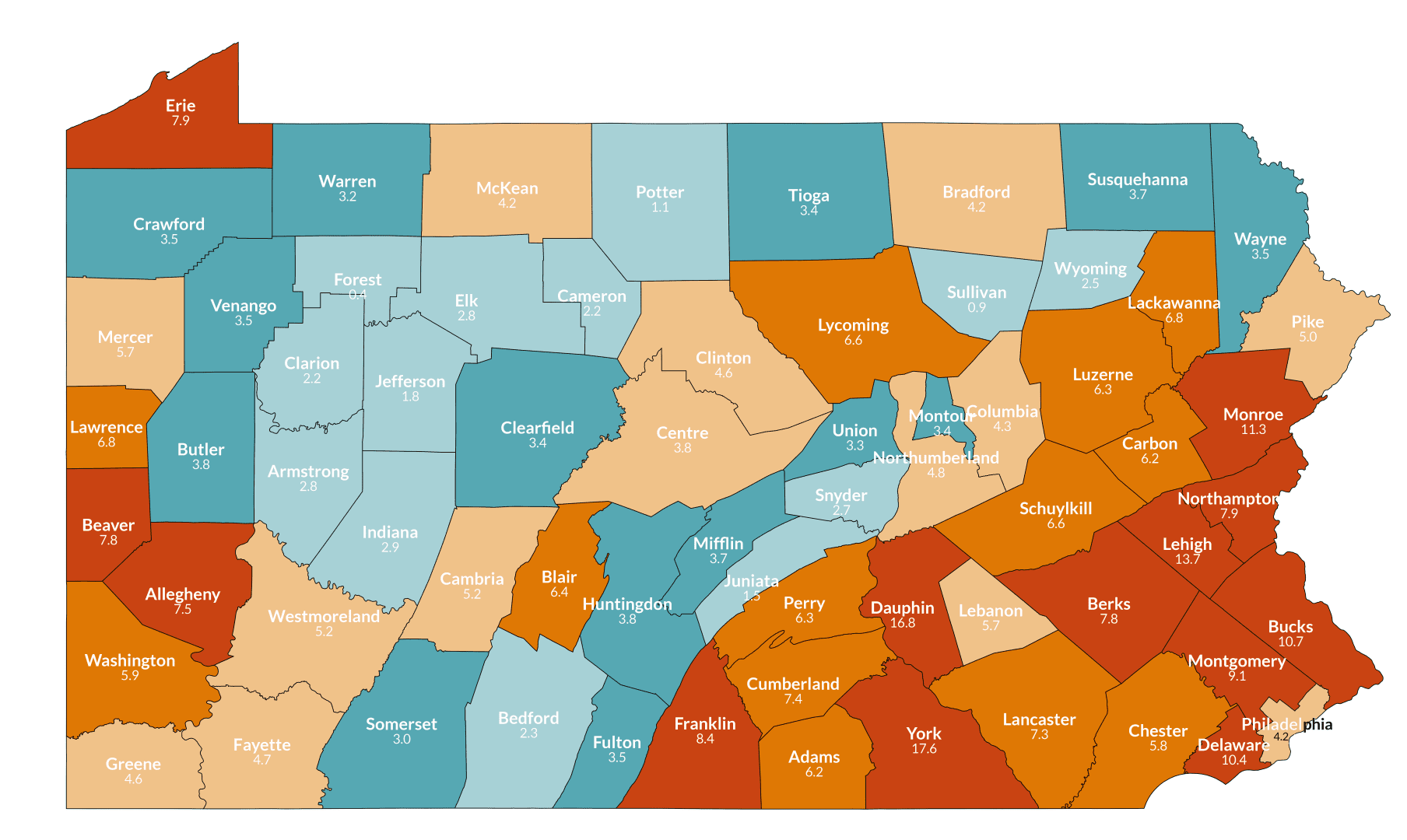
Most Recent Statewide Eviction Data Analysis
Pennsylvania Has Seen 115,619 Evictions in 2024: Here’s a Closer Look

Why We Won’t Stop
Read what our Associate Director Gale Schwartz has to say about why we aren’t stopping on our eviction prevention efforts
Eviction Prevention Resource Library
Eviction Prevention Policy Priorities

Homeless Prevention/ Eviction Prevention Funding
Learn more about one of our top policy priorities related to eviction prevention

Eviction Records Order of Limited Access
Learn more about another one of our top policy priorities related to eviction prevention

Sign-On Letter for Homelessness Prevention Funding
Want to join the effort? Sign on and help advocate for stronger eviction prevention programs.
If you are facing an eviction and need immediate help, visit our Get Help page.
Our Work to Prevent Evictions
We seek to demonstrate that there are win-win solutions to eviction and how programs can be implemented at the local level. The Housing Alliance has prioritized scaling eviction prevention strategies and promoting the replication of these strategies across the state.
We:
– advocate for policies that will prevent evictions and protect renters;
– research and promote smart practices at the local level that are showing impact in preventing evictions;
– convene and engage those on the front lines delivering or seeking to create eviction prevention programs; and
– listen to and engage those with experience of eviction for their policy and program recommendations
The Need
Eviction is a cause of poverty and not a by-product, according to Pulitzer Prize winning author Matthew Desmond.
An eviction on one’s record and even just the filing itself no matter the outcome is a systemic barrier to decent and affordable housing, making it significantly harder for families to convince a landlord to rent to them. These families often end up in housing of poorer quality and in neighborhoods with higher crime and poverty.[1]
There is a critical shortage of affordable homes in Pennsylvania; for every 100 extremely low-income families, seniors, and people with disabilities renting in Pennsylvania, only 39 affordable rental homes are available to them. Because quality homes are scarce and an eviction creates one more barrier to obtaining a new quality home, preventing evictions to help households remain in their homes has to be a priority.
There is A Disproportionate Impact on Renters of Color
Here in Pennsylvania, living in racially/ethnically concentrated neighborhoods, being a single mom with kids, and paying more than 30% of income for rent are each strong predictive factors for who will face eviction.
The disparities along racial and socioeconomic lines demonstrate that eviction is a strong driver of continuing inequities in our system.[2]
The harm of eviction is not limited to either the landlord or the tenant.
– Local employers can struggle to maintain a stable workforce.
– A worker is far more likely to have eviction cause their job loss than experience an eviction due to job loss.[3]
– In communities where there are high rates of student mobility, there is a slower pace of instruction in the schools, higher rates of teacher turnover, and loss of funding due to poor enrollment and performance in addition to harm to the student’s academic performance and socio-emotional development[4].
– Across the US, counties with the highest rates of eviction have the highest rates of all-cause mortality even after considering other social determinants of health such as poverty and education.[5]
A better way of resolving the landlord-tenant conflict besides going to court to evict benefits not only the tenant but the landlord as well. Many landlords share that they do not want to evict tenants and only use it as a last resort when they run out of other options to collect owed rent. It takes time and money to evict a tenant and find a new one.
Eviction was a crisis before the pandemic, and it does not stop with the end of the pandemic.
[1] Desmond, Matthew. “Evicted: Poverty and Profit in the American City.” New York: Crown Publishers, 2016.
[2] Housing Alliance of Pennsylvania. “Revealing Opportunities and Challenges: An Analysis of Eviction Filings in Pennsylvania [Executive Summary].” https://housingalliancepa.org/resources/revealing-opportunities-and-challenges-an-analysis-of-eviction-filings-in-pennsylvania-executive-summary/
[3] Desmond, Matthew, and Carl Gershenson. “Housing and Employment Insecurity among the Working Poor.” Social Problems 63, no. 1 (2016): 46–67. https://doi.org/10.1093/socpro/spv025.
[4] National League of Cities. “The Impact of the Looming Eviction Cliff on School-age Youth.” https://www.nlc.org/article/2020/09/11/the-impact-of-the-looming-eviction-cliff-on-school-age-youth/.
[5] Rao, S., U.R. Essien, T.M. Powell-Wiley, et al. “Association of US County-Level Eviction Rates and All-Cause Mortality.” Journal of General Internal Medicine 38 (2023): 1207–1213. https://doi.org/10.1007/s11606-022-07892-9.